Daylight, Not Heat
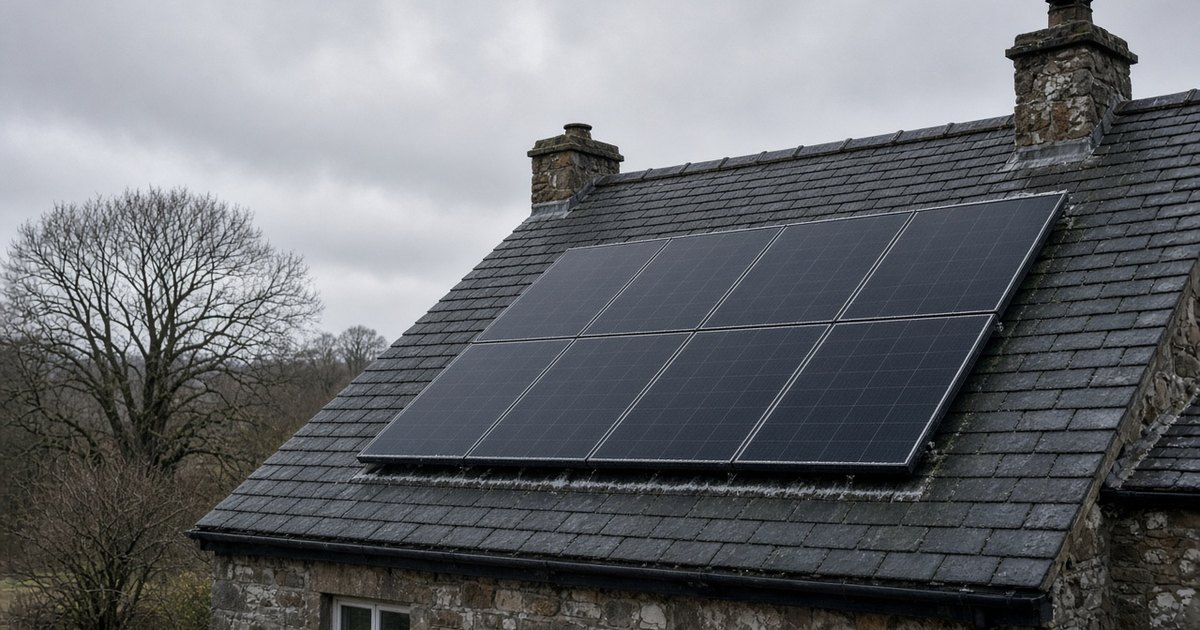
Do solar panels work in winter in Scotland? Yes. They generate from daylight, and a winter day still has daylight, so the roof keeps working. A cold, bright afternoon can be a productive afternoon. The cells respond to light, frost on the garden included. What changes is how much daylight you get, how low the sun sits, and how often cloud sits over the house for the whole of a short day. Heat is the wrong thing to watch.
That is the seasonal fact, stated calmly. Panels on a Scottish roof in January are generating. They are generating less than they do across a long June day, and the household should be planned with that difference in view. If you want the wider question of whether solar is a sound idea here at all, that sits in should I get solar in Scotland. This article stays with the season: what winter does to output, and what a single dark week fails to prove.
What Winter Actually Does To Output
Winter lowers output because the days are short and the sun is low. Generation squeezes into a shorter window around the middle of the day, and a grey lid of cloud can flatten even that. You will see the shape on any honest monitoring app: a run of summer days carries far more generation than a run of December days. We are not going to invent a monthly figure for a typical roof. Shade, pitch, and the direction the roof faces move it too much for a borrowed number to help you.
Take a shape from that, and leave the invented totals alone. Expect the low point in the darkest months and the high point from late spring into summer. A clear, cold week in February can look better than you feared. A thick, grey week in May can look worse. The design is judged on the year. One dark week is a poor reason to decide that panels stop working north of the border. It is also a poor reason to promise yourself a summer every week of January.
Summer Carries More Of The Year
Summer carries more of the year. Long days, a higher sun, and more hours of useful light mean a Scottish roof does a large share of its annual work between spring and early autumn. Those months are what sit under the thin ones. A December screenshot, taken on a wet Tuesday, shows the trough. It hides the months that do the heavy lifting. Households that only open the app in the dark half of the year are reading the hardest chapter and treating it as the whole book.
A system can still reduce the electricity you buy across a full year while winter generation stays modest. The brighter months produce a real surplus. What you do with it, using it at the time, storing it, or letting it leave the house, is a separate choice from whether the panels work. The panels' winter job is smaller. The year's job is the one that decides whether the roof was worth fitting. Design and habit both belong to that longer view.
Snow, Shade, And Short Days
Snow, shade, and short days are the practical winter limits. A thin frost at the edge of a panel usually clears. A proper cover of snow will stop generation until it slides or melts, because the cells need light on the glass. We do not treat deep, lasting cover as the normal week on every Scottish roof, and we do not pretend it never happens on a high or exposed one. The survey notes how exposed the roof is. A postcard winter is a bad brief for a bungalow in a sheltered street, and a sheltered-street assumption is a bad brief for a roof that takes the weather.
Shade reaches further when the sun is low. A tree, a dormer, or a neighbour's gable that barely clips the array in June can cover part of it in December. Short days then compress what remains into a smaller window. This is a layout problem. It is one reason two similar houses on the same street can have different winter output. A higher wattage panel still needs light on its face. We size systems with 455-watt panels, and that wattage does not lift a roof that is shaded at the only hours it could have generated.
Why Usage Still Matters In December
Usage still matters in December. If you are at home in the middle of the day, the winter generation you do get can run the washing, the dishwasher, or the background load directly. That slice is smaller than in summer, and it is still your own power. If you are out, the same slice is more likely to leave the house, and the evening is bought in as usual. The season changes the size of the opportunity. It does not change the logic: power used while it is being made is power you keep.
The evening is the awkward part. Lighting, cooking, and hot water often sit after a winter roof has already stopped. A battery is what can carry daytime generation into that evening, when the capacity and the day's surplus allow it. Whether you need one depends on your pattern, which we have covered in do I need a solar battery. Your own annual statement matters more than a national picture. If you do not yet have last year's figure to hand, start with how much electricity a home uses and then replace the general case with your own.
Design For The Year, Not The Worst Week
Design for the year, including the thin months, and refuse to let the worst week write the specification. A system drawn only to look busy in December will be larger than many homes can use in June, unless storage or a real daytime load is there to meet it. A system written off because December looks quiet ignores the months that produce most of the units. We look at roof, shade through the seasons, and the way you use power, then we put a panel count to that. The darkest fortnight is one input. It is a bad master.
If you want that worked out for your own house, the yearly picture is what goes into a quote, next to the roof and next to shade that only appears when the sun is low. Bring a sense of when you use power. A worry based on one grey week is a hard thing to design from, and an easy thing to correct once the year is on the table. Solar in Scotland is a yearly calculation. Winter is a real chapter. The panels work in it, from the daylight the day actually gives, at a lower level than in summer.
Common Questions
Do solar panels work in winter in Scotland?
Yes. They generate from daylight, so a cold bright day still produces power, though short cloudy days produce less than a long summer day.
Do solar panels need warm weather to work?
They need light on the panel, and cold weather still allows generation. A low winter sun, shade, and short days are what reduce the output.
Should I judge a solar system by a week in December?
Judge it by the year. Late spring and summer do more of the annual work, and a dark week is a poor summary of a Scottish roof.