Surplus Charging In Plain English
Surplus charging means the house takes the power it needs, and the car takes what is left. The panels make electricity only while there is daylight, and the car takes a charge only when it is plugged in. If those two things miss each other, the car does not get solar at that moment. A long June day in Scotland gives you more daylight to share. A short December day gives you less, and the house may use most of it before the car sees any.
Picture a queue. The fridge, the router, and whatever else is on sit at the front. When the array is producing more than that queue, a charger that can see the surplus lifts the charge rate so the car absorbs the rest. When the array is only covering the house, the car waits, draws from a battery, or draws from the grid. You choose that behaviour when the charger is set up. It is a calm arrangement, and it still depends on the roof, the season, and the hours the car is actually on the drive.
What Has To Be On The System
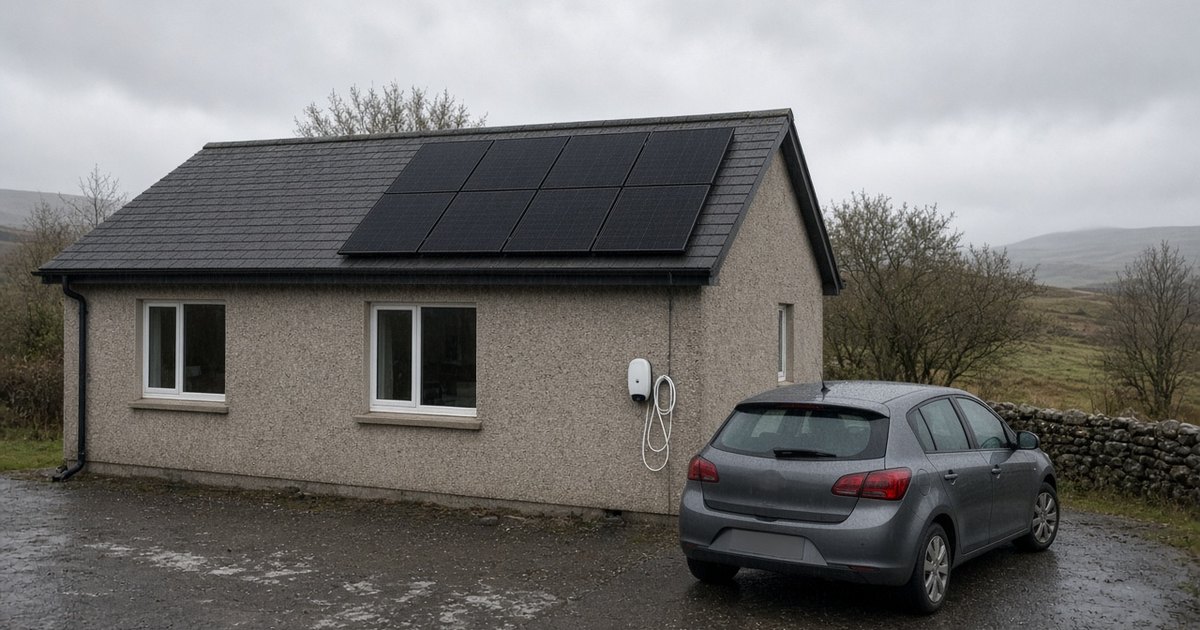
An array on its own does not talk to a car. You need an inverter, which is included on the solar installs we do, and a charger that follows surplus rather than pushing a fixed rate whenever the cable is in. We fit a smart EV charger as part of the system when charging is on your list. It is wall-mounted by the drive and set so the house comes first.
The consumer unit needs a spare slot, or room to add one, and the cable run has to make sense. A charger on the same wall as the board is a simpler job than a drive at the far end of a terrace. On the survey we look at that run, at where you park, and at the miles you do in a normal week. A car that sits at home through the day matches solar more easily than a car that leaves at seven and returns after dark. If storage is still an open question, whether you need a solar battery is the usage decision, kept separate from the charger itself.
Charging While The Sun Is Up
Daytime charging is the straightforward case. The panels are generating, the car is plugged in, and the charger takes what the house is not using. On a bright spring or summer day that can be a useful share of a commute, especially if the car does not come home empty every night. You can still get a charge under cloud. Panels work from daylight, so a bright overcast day in Scotland produces something. It produces less, and a surplus setting should follow that lower output rather than topping the car up from the grid.
The habit that helps is leaving the car connected when it is at home in daylight, not only after dark. That is easier if you are home some weekdays, or if a second car stays put. When the only car is gone from early morning until evening, the surplus goes elsewhere: into the house, into a battery, into hot water through a diverter, or out to the grid as export. The car is one use of solar. How to use more of your own solar power covers the wider set of habits, including the ones that do not involve a driveway.
Evening Miles And A Battery
Most commutes are plugged in during the evening, because that is when the car is home. By then the panels have stopped, or they are down to very little. An evening charge without a battery is a grid charge. The array has not failed. The timing did not overlap. A battery can take surplus through the afternoon, while the house is quiet, and hand it to the car later. It can also cover the house in the evening, so those units are not all bought in as well.
The battery has to be large enough for the job you actually want. A smaller unit may cover lights, cooking, and the television, and still have little left for a car. The Sigenergy 10 kWh battery we fit, or a Tesla Powerwall 3 at 13.5 kWh, holds more of an afternoon's surplus. A car can still ask for more than a home battery stores. A Duracell 5 kWh battery can be a starting point, with another unit added later. We size storage against your evening and the miles you hope to cover from it, and we say plainly what is left for the grid.
The Pence Per Mile Illustration
People ask what a solar mile costs beside a grid mile. A fair illustration is about 2p a mile from solar versus about 7-10p a mile from the grid. It depends on surplus, the tariff, and the car. When the car charges from the grid because the panels were already busy with the house, you are on the grid side of that illustration. When a slice of the charge came from surplus, that slice is the lower one. Treat it as an illustration. It is not a rate we can fix for your house.
A small array and a long commute may cover only a modest share of the miles. A larger array, a car that is home in daylight, and a battery for the evening can cover more. Your annual electricity statement and a rough weekly mileage tell us which household you are. Export is power that left the house. A solar mile, in this illustration, is a mile from power that went into the car or into a battery that later fed the car. Those are different outcomes, and the survey is where we separate them.
Size The Array For The Car And The House
The car should not be the only number in the design. The house still has a kettle, a washing machine, and an evening of its own. We size systems with 455-watt panels, usually from 6 to 16. Six panels is about 2.7 kW, ten panels is about 4.6 kW, and sixteen is about 7.3 kW. A car on top of ordinary home use often points towards the middle or the top of that range, if the roof can take it. What size solar system you need is the wider piece. Here the extra question is whether one roof can carry the house and a share of the miles together.
On the survey we look at roof space, shade, where the car parks, and the consumer unit. We ask which days the car is home while the panels are generating. That visit carries no obligation to go ahead. We handle DNO registration as part of the install, and a typical job takes about two to four working days, with a dedicated project manager. If the roof cannot take a large array, we say so. A battery and a charger that prefers surplus can still be a sound design when the roof is modest.
Common Questions
Can I charge an electric car with solar panels if the car is at work all day?
Only on days it is home while the panels are generating, unless a battery has stored surplus for later. A charger that prefers surplus still helps when the car is on the drive in daylight.
Do I need a home battery to charge an electric car from solar?
You can charge straight from the panels when the car is plugged in during daylight. A battery is what lets afternoon surplus cover a charge once the sun is down.
Will rooftop solar cover every mile I drive?
That depends on the array, how often the car is home in daylight, and how far you drive. Many households cover a share from solar and the rest from the grid.